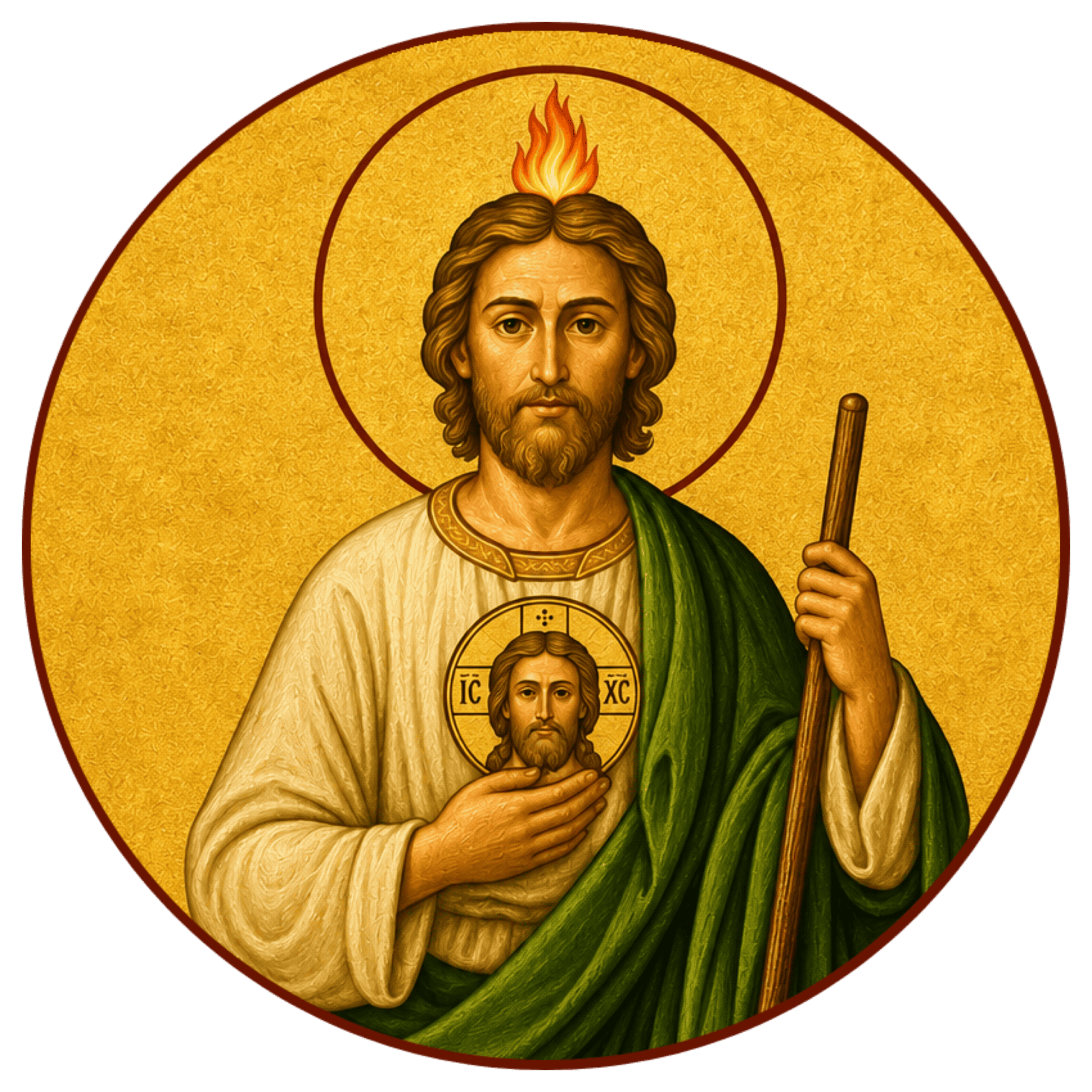
We’re excited to celebrate our 80th anniversary as a parish this year! On Saturday, August 22, 2026, we hope you’ll join us for a special Mass (at 4:00pm) with the Bishop and a parish picnic immediately following the Mass.
This event is free and open to all parishioners, families and friends.
RSVP Here so we know how much food to prepare.
Volunteer to help Here because many hands make light work!
Trivia Questions
Each week leading up to our anniversary celebration, we’ll be posting a trivia question. The following week, we’ll post the answer!
How much do you know about the Parish of St. Jude? Click on the question to reveal the answer!
Some quick math will tell you that it was 1946. But did you know that our parish was established in MAY of 1946? The chaplain that was assigned to the Michigan Veterans Facility was experiencing an increase in the number of people attending the Masses in the chapel. In May 1946, the 75 families were officially named parishioners of St. Jude Parish, as founded by Bishop Francis. J Haas. A year later, the congregation was over 100 families. The parish met for its first four years at the Michigan Veterans Facility chapel. And to this day, the pastor of St. Jude still celebrates Mass there once a week.
The first pastor of St. Jude Parish was Fr. Ralph J. Kelly, after whom the “Kelly Conference Room” is named. Fr. Kelly had recently been discharged from the United States Army and was assigned to serve as chaplain to the Michigan Veterans Facility where the Parish of St. Jude was born. Fr. Kelly served as pastor of St. Jude Parish until 1952.
In 1950,the Parish of St. Jude occupied its first home in two WWII surplus Quonset huts on Plainfield Avenue, where the current Plainfield Plaza is located today. One Quonset hut served as the church and the other a parish hall. A brick rectory for the parish was also added that year. Plans to continue developing the parish grounds were put on hold when it was learned that Plainfield Avenue (then US – 131) was to be widened into a four – lane highway. Eventually, plans for the I – 96 highway were made and the property was rezoned and sold. A larger, more desirable site was needed.
1946 – 1952: Fr. Ralph Kelly
1952 – 1988: Msgr. Charles D. Brophy
1988 – 1995: Fr. Patrick Cawley
1995 – 2003: Fr. Thomas Vesbit
2003 – 2009: Fr. Michael Danner
2009 – 2022: Fr. Thomas Page
2022 – present: Fr. Ayub Francis Nasar
On July 4, 1953, a fire burned the church Quonset hut. Father Brophy had spilled some wine while filling the cruets over a waste basket. Not wanting to attract ants into the church, he threw a match into the basket which he thought was made of metal. The resulting fire destroyed the church Quonset Hut, although the distraught pastor saved the Blessed Sacrament and the sacred vessels. The other Quonset hut now became both the church and the parish hall.
August 15, 1955 – the Solemnity of the Assumption of the Blessed Virgin Mary – was when the purchase of the property between Elmdale and Four Mile Road was completed. Fr. Brophy developed a portion of the property for residential housing (to help fund the construction of the new church and school), naming the road “Assumption Drive” after the feast day on which the property was purchased. The groundbreaking for the school, temporary church and convent buildings occurred just four months after the property was purchased.
In October of 1957, St. Jude School opened for its first academic year. At the same time, Mass was first celebrated in the “temporary church” building (which is our present-day gymnasium). The convent was also opened (present-day Thaddeus Center) and occupied at this time. The brick rectory, that was originally constructed on Plainfield Avenue, was moved to the new site and has served as our rectory to this day.
Sister Florentine, the school’s first Principal, and her community of sisters occupied the convent and became the first teachers of St. Jude School. They were of the order of the Sisters of Saint Felix of Cantalice, who embrace the Franciscan Spirituality, trace their origins to their founding in Poland by Blessed Mary Angela Truszkowska in 1955. Their North American Motherhouse is located in Livonia, Michigan.
An incredibly fast 15 months! Construction moved at a whirlwind pace in the 1960s. Ground was broken on August 5, 1962 and the project moved so quickly that parishioners were able to celebrate the very first Mass inside the new church on Thanksgiving Day, November 28, 1963. The building was later formally dedicated by Bishop Allen Babcock on June 7, 1964.
Aside from our visible crosses, the answer is around 100,000! The brick pattern used inside and outside our church is called the English Cross Bond. If you look closely at the walls, you’ll see alternating rows: one row shows the long sides of the bricks and the next shows the short ends (which look like half-bricks).
The brilliant geometry of this pattern means that every cluster of three bricks forms a perfect cross. The next time you are in church , take a close look at the walls and see how many you can spot!
Saint Jude, Monsignor Brophy and Bishop Allen Babcock. Which bell bears which name is a fact lost to history. What’s your guess?
Sculptor Gerald Bonnette modeled the statue after “The Woman of the Apocalypse” from the Book of Revelation (12:1). Scripture describes “a woman clothed with the sun, with the moon under feet, and on her head a crown of twelve stars.” While this figure has a few meanings in theology (including representing the Church, Israel and the Virgin Mary as the Queen of Heaven), she is beautifully mirrored in our statue. Her bronze gown was crafted to catch the light like the sun, and you can see the crescent moon resting beneath her feet. If you look closely at her crown, how many stars do you count?
There have been 25 Associate Pastors at St. Jude Parish since it was founded in 1946. Seventeen of them served during Monsignor Brophy’s 36 year tenure as pastor; 3 under Fr. Pat Cawley; 3 under Fr. Michael Danner; and 2 under Fr. Tom Page. Here is the list in the order that they served:
- Fr. Leo Zielinksi
- Fr. John Sullivan
- Fr. Herman Kolenda
- Fr. Thomas Dominiak
- Fr. Francis Hackett
- Fr. Richard VanLente
- Fr. Thomas McKinney
- Fr. Stephen Vesbit
- Fr. Patrick Cawley
- Fr. Martin Toolis
- Fr. James Kowalski
- Fr. William Langlois
- Fr. Ernest Schneider
- Fr. Thomas Simons
- Fr. Charles Hall
- Fr. Thomas DeYoung
- Fr. Edward Hankiewicz
- Fr. George Darling
- Fr. John Vallier
- Fr. Michael Ruthenberg
- Fr. Godfrey Onyekwere
- Fr. Fredrick Brucker
- Fr. Mark Peacock
- Fr. Thomas Cavera
- Fr. Danny Orris
Come back next week for the answer!